




Event Timeline
About ENS
Ethereum Name Service is a protocol that issues non-fungible tokens that can represent Ethereum addresses as well as web domains. It replaces long wallet addresses like 0x7a3f... with simple human-readable names like yourname.eth, making crypto transactions, Web3 profiles, and dApp logins significantly easier for everyday users.
Built by Nick Johnson, a former Google engineer, ENS launched in 2017 as part of the Ethereum Foundation and spun off as an independent organisation in 2018. By the time of the token launch in 2021, over 230,000 unique .eth names had been registered. The November 2021 token launch decentralised governance of the protocol entirely. "ENS is for the people. No investors, decentralized, and the community can now set the key parameters of the protocol. This is the essence of Web3."
Airdrop Stats
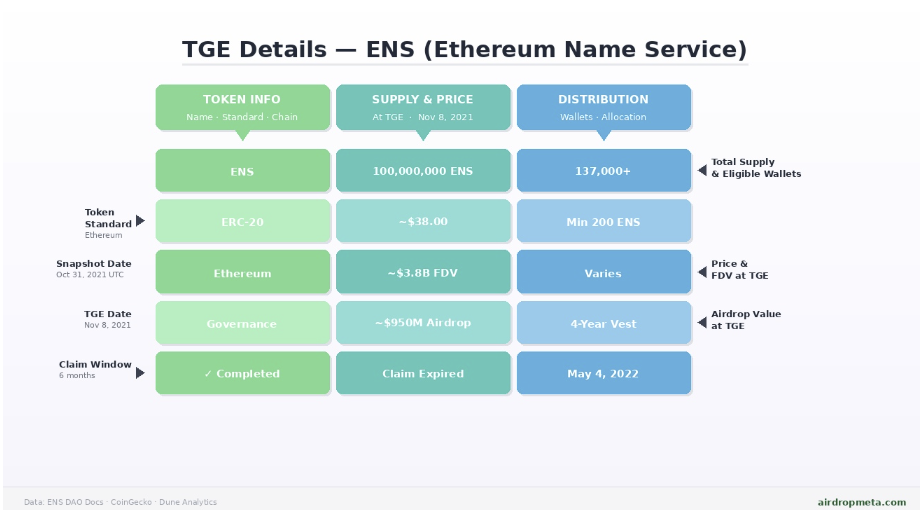
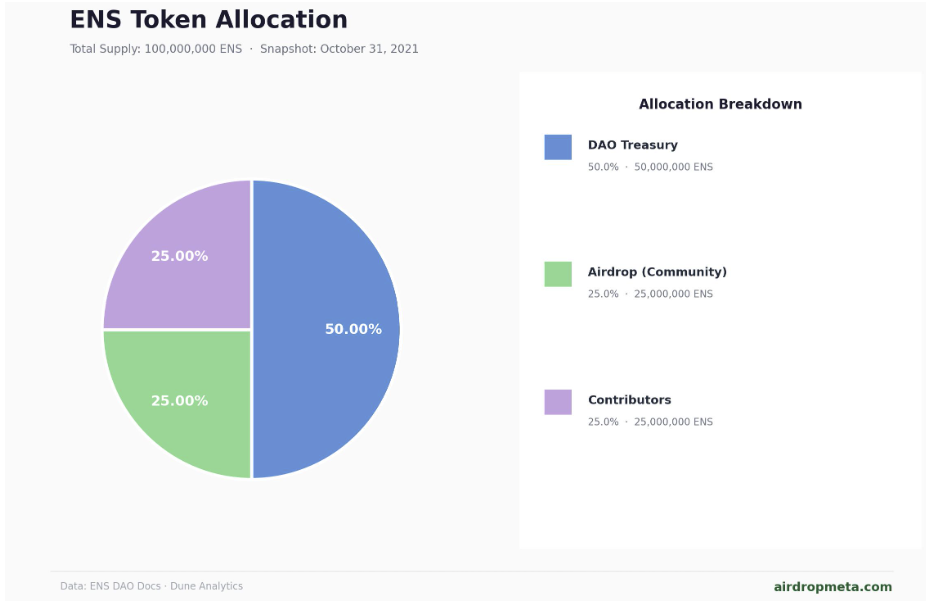
50% of total supply (50 million ENS) was distributed to the DAO treasury at launch, with 10% available immediately and the remaining 45 million unlocking linearly over four years. 25% went directly to the community airdrop. The remaining 25% covers contributors. No VC allocation, no investor bucket. One of the most community-first distributions in all of Web3.
How It Worked to Get the ENS Airdrop
Register a .eth Name
Register Early and Long
Set a Primary Name
Vote Before Claiming
Was the ENS airdrop worth it?
Yes. The ENS airdrop stands alongside Uniswap as one of the greatest retroactive airdrops in crypto history.
- The effort required was simply registering a .eth name and using it. Registration fees in the early years were minimal. Long-term users who had held names since 2017 or 2018 received allocations of 500 to 1,000 ENS or more, worth up to $85,000 at the all-time high. Even a minimal allocation of 200 ENS was worth $17,000 at ATH. The governance-first claim process made every recipient an immediate DAO participant, a level of design intention that remains unmatched.
ENS Official Links
Official channels, documentation and community for this airdrop:
This airdrop has concluded. It is kept for research rather than participation.